
I-DLM Revolution: Diffusion Models Finally Match Autoregressive AI in Quality and Speed
Researchers from Together AI, Stanford, and Princeton have unveiled I-DLM, the first diffusion language model to match autoregressive quality while delivering up to 4x higher throughput.
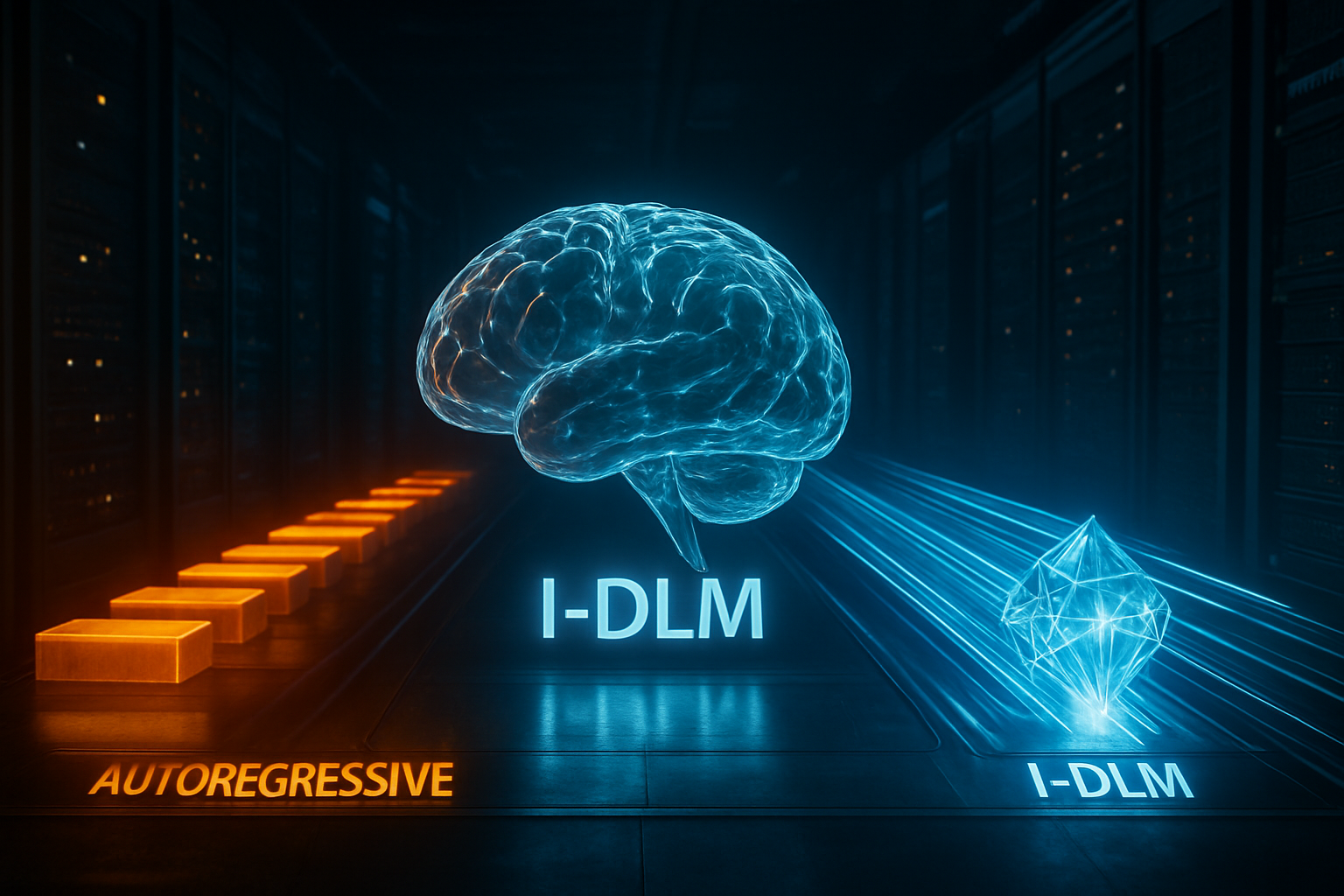
Key Points
- I-DLM is the first diffusion language model to match the quality of autoregressive (AR) models like Qwen3.
- Delivers 2.9x to 4.1x higher throughput compared to competitors like LLaDA at high concurrency.
- The innovative ISD technique enables simultaneous token verification and generation in a single forward pass.
- R-ISD feature provides bit-for-bit identical output to base models using gated LoRA adapters.
- Fully compatible with SGLang infrastructure, requiring no custom software or hardware changes.
- I-DLM-8B outperformed models twice its size in mathematics (AIME) and coding (HumanEval) benchmarks.
The artificial intelligence landscape has long been defined by a fundamental trade-off: the choice between high-quality reasoning and lightning-fast generation. Autoregressive (AR) models, the backbone of giants like GPT-4 and Llama, dominate the industry due to their exceptional logical capabilities. However, they suffer from an inherent sequential bottleneck, generating tokens one by one. Conversely, Diffusion Language Models (DLMs) promised to shatter this limitation through parallel generation, but they historically struggled to match the intellectual rigor and consistency of their AR counterparts. Today, that paradigm shifts with the introduction of the Introspective Diffusion Language Model (I-DLM) by a collaborative team from Together AI, Stanford, Princeton, and UT Austin. I-DLM represents a massive leap in AI software engineering by addressing what researchers identify as a "failure of introspective consistency." In previous DLM iterations, the models often failed to "agree" with the tokens they had just generated, leading to a breakdown in quality during complex tasks like mathematical theorem proving or advanced coding. I-DLM solves this via a breakthrough technique called Introspective Strided Decoding (ISD). This method allows the model to verify previously generated tokens while simultaneously proposing new ones in a single forward pass. This dual-action approach not only maintains quality but enables real-time self-correction, making I-DLM the first diffusion model to match the quality of same-scale AR models. On the technical front, the benchmarks for I-DLM-8B are nothing short of revolutionary. In the AIME-24 competition—a rigorous test of mathematical reasoning—I-DLM-8B scored a 69.6. To put this in perspective, LLaDA-2.1-mini, a prominent competitor with double the parameters (16B), managed only a 43.3. In coding benchmarks like LiveCodeBench-v6, I-DLM-8B achieved a score of 45.7, significantly outperforming the 30.4 scored by its rivals. These results demonstrate that the underlying infrastructure of diffusion models has finally reached a level of maturity suitable for intensive commercial and technical applications, proving that size isn't the only factor in AI performance. One of the most compelling aspects of I-DLM is its throughput efficiency. By processing multiple tokens simultaneously, the model delivers 2.9x to 4.1x higher throughput than traditional models under high-concurrency workloads. Furthermore, the researchers introduced a specialized variant called Residual ISD (R-ISD) utilizing gated LoRA adapters. This technology ensures that the output is bit-for-bit identical to the base AR model, effectively providing the speed of diffusion with the exact precision of sequential decoding. For developers, this means the ability to accelerate existing applications without rewriting logic or sacrificing the reliability of the model's responses. Integration with existing ecosystems was a primary focus for the development team. Unlike prior DLMs that required custom, fragmented infrastructure, I-DLM is designed for seamless deployment. It utilizes strict causal attention, allowing it to be integrated directly into production-grade serving frameworks like SGLang. The model benefits from advanced optimizations such as Paged KV cache, continuous batching, and CUDA graph capture, which can boost throughput by an additional 42-76%. This compatibility ensures that transitioning from a traditional AR model to I-DLM is a straightforward process for data centers looking to reduce operational costs and latency. Ultimately, I-DLM is more than just a new language model; it is a proof of concept that redefines the future of AI training and inference. By merging the strengths of parallel generation with internal verification mechanisms, the research team has dismantled the barriers that held diffusion models back for years. With the code and weights now available to the public, we are entering an era where high-speed processing and high-quality reasoning are no longer mutually exclusive. I-DLM paves the way for a new generation of AI assistants that are not only faster but capable of handling the world's most complex logical challenges with unprecedented efficiency.
Bridging the Speed-Quality Divide
For years, Diffusion Models remained a theoretical promise in NLP, often lagging behind sequential models in output quality. I-DLM addresses this through 'Introspective Consistency,' combining the speed of parallel generation with the precision of self-review. This ensures the model doesn't just predict the next word but reviews the entire context to maintain logical flow, effectively solving the hallucination issues common in earlier diffusion attempts.
Exceptional Performance in Math and Code
Test results prove that I-DLM-8B is as intelligent as it is fast. In the AIME-24 benchmark, the model achieved a massive lead over LLaDA models, proving its capability in solving complex mathematical problems that require multi-step reasoning. Furthermore, its dominance in HumanEval and LiveCodeBench makes it an ideal tool for developers who demand both rapid iteration and high-fidelity code generation.
ISD Technology and Parallel Generation
The core of I-DLM's power lies in Introspective Strided Decoding (ISD). This technology breaks the traditional 'one-token-at-a-time' rule. By using strides, the model can propose a cluster of tokens and verify them instantly. This approach significantly reduces the number of forward passes needed to generate text, translating directly into reduced energy consumption and faster response times for the end-user.
Seamless Deployment and Software Integration
I-DLM is designed as a 'drop-in replacement' for existing systems. With native support for SGLang and the use of causal attention, organizations can swap their current AR models for I-DLM without redesigning their server infrastructure. Advanced optimizations like Paged KV cache ensure that the model runs at peak efficiency on modern GPUs like the NVIDIA H100, maximizing hardware ROI.
This article was drafted with AI assistance and editorially reviewed before publication. Sources are listed below.