
Is LLM Steering the Future of Controlling AI Behavior?
With the arrival of tools like DwarfStar 4, direct manipulation of LLM activations—or 'steering'—is becoming a hot topic. Can we replace prompting with internal control dials?
Key Points
- DeepSeek-V4-Flash is a powerful local model capable of competing in agentic coding tasks.
- DwarfStar 4 integrates 'steering' as a first-class feature for local LLM manipulation.
- Steering allows for behavioral control by manipulating internal activation vectors during inference.
- Runtime steering offers a way to bypass model refusals without the risks of permanent weight-based fine-tuning.
- The potential for steering to enhance 'intelligence' remains debated compared to standard prompt engineering.
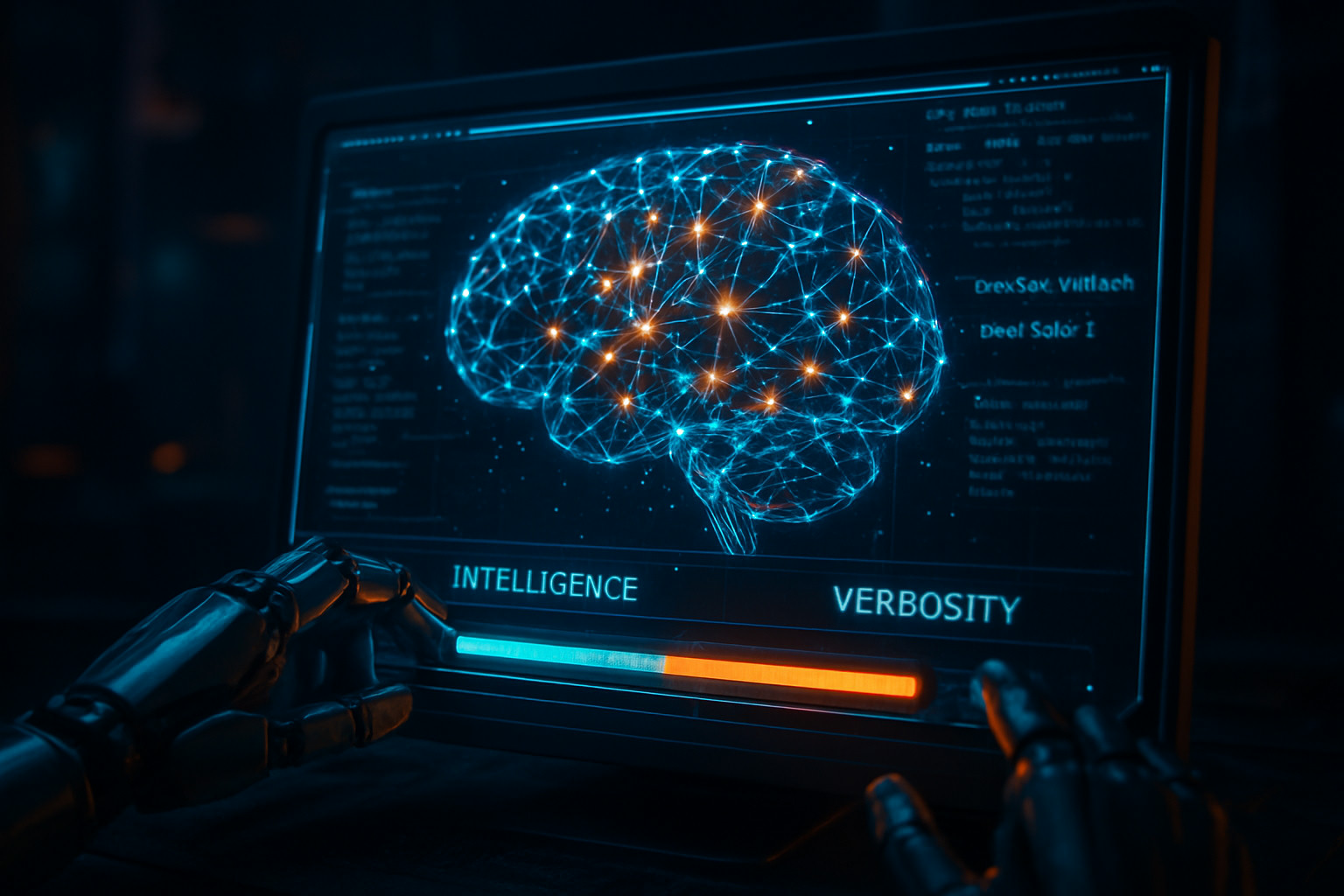
Ever since the emergence of Golden Gate Claude, I have been fascinated by the concept of "steering." The idea that we can guide an LLM’s output by directly manipulating its internal activations mid-flight is, in my view, one of the most compelling frontiers in AI research. It feels like moving from being a user who talks to a black box to someone who can reach inside and tweak the dials of the machine's own mind. With the recent release of DeepSeek-V4-Flash, this concept is shifting from an academic curiosity to something practical for engineers. My interest was piqued by the project DwarfStar 4, an iteration of llama.cpp stripped down specifically to run DeepSeek-V4-Flash. What makes this model so significant? It represents a threshold moment: a local model capable of competing with the low end of frontier agentic coding models. Because steering requires direct access to the model’s internal states, it was previously out of reach for most. Now, with antirez baking steering into DwarfStar 4 as a first-class feature, we are seeing the beginning of a new paradigm where developers can experiment with these internal controls directly. How does this actually work? At its core, steering involves extracting a specific concept—like "respond tersely"—from the model's internal brain state and boosting those activations during inference. One standard approach is to feed the model a set of prompts twice: once normally and once with the target instruction appended. By subtracting the activation matrix of the first from the second, you isolate the "steering vector." In theory, you can apply this vector to any subsequent prompt to force the model to adopt that specific behavior. There are, of course, more sophisticated methods. Anthropic’s work with sparse autoencoders is a prime example, where researchers train a second model to extract patterns of behavior from the primary model’s activations. While this is more computationally expensive and requires significant expertise, it allows for the identification of deeper, more nuanced features than the naive approach. I think of this as finding the "smart" dial in the model’s brain and turning it to the right, rather than painstakingly assembling training data to nudge the model toward intelligence. So, why don’t we see these steering panels in ChatGPT or Claude? The reality is that steering occupies a strange "middle class" in AI research. The big labs don’t need it; they can just retrain the model to behave as they want. For the rest of us, we are typically restricted to API access, which hides the model weights and activations needed for steering. Furthermore, most basic steering tasks are already outcompeted by simple prompt engineering. If I can get a model to be verbose by asking it to be, why go through the trouble of performing "brain surgery" on the model’s activations? However, the real promise of steering lies in concepts that are "unpromptable." Can we steer for "intelligence"? I am skeptical. Current models are already trained to sound expert; prompting for it does little. If we try to isolate an "intelligence" vector, we might find that the concept is so deeply embedded in the model’s weights that the steering vector is essentially a mirror of the entire model. At that point, you aren't making a small model smarter; you are just using a different model to guide it. As I have argued elsewhere, the intelligence resides in the steering, not the model being steered. Another potential application is data compression. What if we could encode vast amounts of knowledge—like an entire codebase—into a steering vector? Instead of flooding the context window with documentation, we could theoretically "steer" the model to know the code. While I suspect this will ultimately require the same depth of fine-tuning as traditional methods, the possibility is intriguing. It would effectively move knowledge from the model’s working memory to its implicit memory. I’ve been following the community reaction, including insights from antirez, who noted that steering can bypass certain "trained-in" behaviors, like refusals, in ways that prompting cannot. This is a game-changer. While I previously thought uncensored models were strictly the result of LoRA fine-tunes, it turns out runtime steering is a viable, lightweight alternative that doesn't risk the degradation often associated with weight-based fine-tuning. This, to me, is the most practical use case for the immediate future. Ultimately, while I am not fully optimistic that steering will replace training, I am convinced that the open-source community is just getting started. If I am wrong and steering proves to be a powerful tool for customization, we will know within six months. Will we see a "library" of boostable features for every popular open-weights model? I certainly hope so. As we move forward, the question isn't just what these models can do, but how much control we can exert over their internal logic without breaking them. Are we ready to take the wheel?
Understanding LLM Steering
Steering is a technique that enables developers to modify an LLM's output by accessing its internal states. Instead of relying solely on prompt engineering, we boost specific activation patterns within the model's digital neurons to ensure consistent behavior. For engineers, this means the ability to tune 'dials' like verbosity or conscientiousness directly. It represents a shift from treating AI as a black box to understanding its internal mechanics and molding them for specific tasks.
The Future of DwarfStar 4 and Local Models
DwarfStar 4 is changing the landscape by providing a streamlined platform to run DeepSeek-V4-Flash with built-in steering tools. This lowers the barrier to entry for developers looking to explore the capabilities of open-weights models. I believe this trend will empower the community to build 'feature libraries' that can be applied to various models, reducing reliance on the closed-source, proprietary models controlled exclusively by big tech firms.
This article was drafted with AI assistance and editorially reviewed before publication. Sources are listed below.